Wednesday, May 4, 2016

More Lesson Closure Ideas

Ask questions:

  • What is one thing you learned today?
  • How does today's lesson impact your understanding of _______________?  
  • How would you summarize today's learning for someone who wasn't here? 
  • What was the most significant learning from today?
  • What "a-ha" did you have today?
  • What was the most difficult concept in today’s lesson?  Why?
  • What should I review further in our next lesson?

If you are running short on time:

  • On a scale of 1-5—using your fingers—rate today's lesson. To eliminate peer pressure, have everyone close their eyes.  
  • Whip around:  Have each student share one word or concept they learned.


Get-Out-of-Class Ticket

  • Ask students to write down one potential TEST QUESTION from today's lesson. Collect them as your students leave the room, a ticket out of class, if you will. Hang on to them. You might want to use one or two on an upcoming unit exam. This also provides a chance to personally connect. Saying goodbye is an opportunity to build up individual relationships with your students which, in turn, helps build up a positive classroom culture.


This article was also used for this post.


Wednesday, April 27, 2016

Ending Your Lesson Using Best Practices

 Coaches and administrators throughout the district have been going into classrooms for the yearly spring Data Collection, observing and recording best practices throughout the lesson.  If the observer is in the classroom at the end of the period, he/she looks for best practices in the lesson closure. The benefits of a strong lesson closure are well-documented and can be summarized as follows:  Closure summarizes the current lesson, allows for a check to see “did my kids get it,”and helps inform teacher planning for the next lesson.  Closure provides that critical bridge that brings sense and sequence to a series of lessons within a unit.

What do coaches and administrators look for in a lesson closure?
Coaches and administrators in Tahoma School District look for the following when they are in an end-of-lesson Data Collection:

If you have questions about what these look like in a lesson, please contact your  building coach or administrator.

What do others say about lesson closure?
Dr. Rod Lucero, Associate Professor in the School of Education and the Associate Director for the School of Teacher Education and Principal Preparation (STEPP) at Colorado State University, says that “closure activities also help define both your teaching agenda and the intended learning progression, weaving today's lesson with yesterday's while providing a look ahead at what tomorrow's will bring. As a deliberate part of your planning process, these activities summarize the current lesson, provide it context, and build anticipation for the next. Properly implemented, they will help you establish and maintain course momentum. Reinforcing what students have learned, closure activities also serve as an assessment tool with which to evaluate your students retention level—Did they get it?—as well as your own effectiveness.”   (http://teaching.colostate.edu/tips/tip.cfm?tipid=148).

How do lesson closures relate to TPEP?
Allowing a few minutes for a brief summary and student assessment and/or reflection not only meets Criteria 6.1, “Self-assessment of learning connected to the success criteria,” but also meets 6.3, “Formative Assessment Opportunities”; 6.5, “Student use of assessment data”; and 3.2, “Ownership of Learning.”  All of this for a brief time-out to synthesize the day’s learning!


Next week:  Fun ideas to liven up your closures

Wednesday, April 20, 2016

Two Don'ts and a Do: Asking questions to get students to analyze, make inferences, and generalize


Dylan Wiliam, author of Embedded Formative Assessment, cites a large research study by Ted Wragg  and colleagues that analyzed 1000 questions asked by teachers (79).  Of those 1000 questions, only 8% required students to analyze, make inferences, or generalize.

As we begin the slow slide towards summer, how can you improve your questioning AND keep your students more actively engaged?


DON’T OVERUSE I-R-E QUESTIONS.
Example
Teacher: “Who can tell me what a simile is? Mike?”
Student: “A simile compares two different things using ‘like’ or ‘as.’”
Teacher: “Good job.”

The sequence above is an I-R-E model, one that teachers should use only minimally. Why? In this model, the teacher is speaking  2/3 of the time, and only one student at a time can speak. The conversation is unnatural, one that seldom occurs in any other setting, and there is usually only one correct answer. Students quickly learn to play the game, to raise a hand to offer up the desired response, and to tune out until their name is called. a


DON’T OVERUSE THESE TYPES OF QUESTIONS:
Management questions (57% of questions in the Wragg study)
 Recall questions (33% in the Wragg study)


DO ASK QUESTIONS DESIGNED TO
Cause your students to think
Provide information for the teacher about what to do next


Would you like some CCS Reading Standard-aligned sentence starters to make your questions deeper and richer, force your kids to think, and prepare them for college and career at the same time?


Tuesday, April 12, 2016

Changing Your Practice Takes Practice

Do you ever feel like you want to change an aspect of your teaching practice but are frustrated when you try something new?

On average, a teacher needs to practice a new skill 20 times before mastering it. This number increases if the skill is exceptionally complex.

The biggest challenge in learning a new skill is not in learning it, but in implementation. For example, learning about riding a bicycle is much simpler than actually riding a bicycle.

Changing one's practice is further complicated by the fact that most teachers only change their underlying beliefs after they see success with students.  This creates a catch-22 situation where teachers often abandon a practice before they are able to master the skill and are see success with their students.

Give yourself grace when you try to implement a new practice that has been shown to enhance student learning.

Want to learn more?  Check out Allison Gulamhussein's "Teaching the Teachers" report published by the Center for Public Education.


Wednesday, March 30, 2016

Incorporating Physical Activity for Greater Learning


With two more days to go and brilliant sunshine outside, your students are undoubtedly squirmy and a bit unfocused.  How can you easily refocus them?  How can you incorporate physical activity into your classroom to make your students more engaged and ready to learn?


Check out the new Tahoma Active Schools website, a project of Tracy Krause, Jeana Haag, and Sara Russell, with website creation by Rick Haag.  Get a wealth of Brain Energizer ideas, and watch videos of Tahoma secondary classroom teachers incorporating physical activity into their classrooms.


Monday, March 21, 2016

Increasing Student Engagement and Rigor with Student Talk

Teachers often feel as though they need to debrief any student talk (pairs, small groups) with the entire class. Consider this for keeping the momentum up in your class.

Rather than calling on students after a pair share or small group discussion, circulate around the room during that discussion time and note the BEST THINKING that you hear.  

You could write on a small whiteboard, and then you could hold it up to show students your notes, or you could write notes on a clipboard and display them using the document camera. When you bring the class back together, share the BEST THINKING and use student names.  

Advantages:
  • Everyone hears the BEST THINKING.
  • BEST THINKING provides a model for rigorous work for the entire class.
  • You elevate student status by naming students who demonstrated good thinking.
  • It’s quick—you can share what you heard in a minute or less, and keep the momentum of the class going toward the next activity.
  • Listening to pairs/groups provides you with a formative assessment opportunity, and gives you the opportunity to address any misconceptions students may have.
  • Shy or introverted students will be less intimidated sharing in a pair or small group, and elevated when you share their good thinking.


Students talk in pairs = 100% of students participate
Teacher calls on 5 students in a class of 32 = 16% of students participate


Tuesday, March 15, 2016

The power of students setting goals and monitoring progress

In chapter three of Leaders of Their Own Learning, Ron Berger tells us that "Using data with students encompasses classroom practices that build students’ capacity to access, analyze, and use data effectively to reflect, set goals, and document growth." 

What does that mean exactly?  

Using data with students encompasses the following activities:
  • Students use their classwork as a source for data, analyzing strengths, weaknesses, and patterns to improve their work.
  • Students regularly analyze evidence of their own progress. They track their progress on assessments and assignments, analyze their errors for patterns, and describe what they see in the data about their current level of performance.
  • Students use data to set goals and reflect on their progress over time and incorporate data analysis into student-led conferences.
Berger continues by elaborating. "Teachers and school leaders everywhere collect and analyze data to make informed decisions about instruction that will support all students in meeting state and Common Core standards. However, in many schools, the power of data to improve student achievement is not fully leveraged because students are left out of the process. The most powerful determinants of student growth are the mindsets and learning strategies that students themselves bring to their work—how much they care about working hard and learning, how convinced they are that hard work leads to growth, and how capably they have built strategies to focus, organize, remember, and navigate challenges. 

When students themselves identify, analyze, and use data from their learning, they become active agents in their own growth. They set personal goals informed by data they understand, and they own those goals. The framework of student-engaged assessment provides a range of opportunities to involve students in using data to improve their learning.  Using data with students has the potential to build reflective and confident learners with key dispositions of college and career readiness.

The below examples are how teachers in our system are doing just what Berger explains above.  The power and impact is amazing.

Students Reflecting and Setting Goals
Teacher Moves
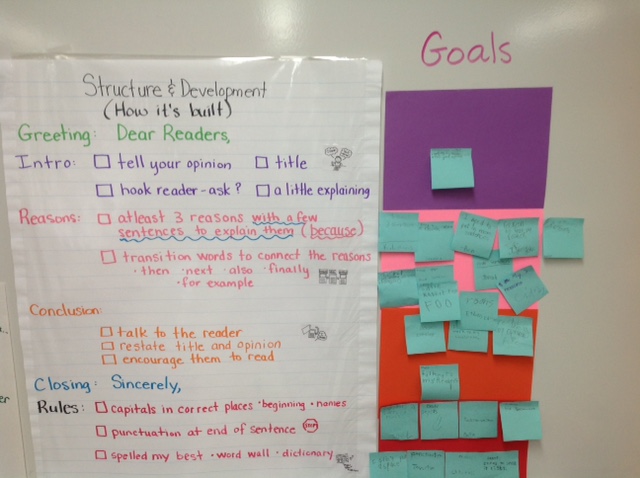
2nd gr goal setting - Mason.jpg
In this 2nd grade example, students created their own version of the Units of Study Opinion Writing Checklist with their teacher. Then, they looked at the opinion letter they had previously written, referred to the checklist and set goals to address what was missing or what they could get better at. In order for their goal to be more obvious and to keep the checklist visible, the teacher color coded each possible goal section for students to place their name and goal. This makes it easy for the teacher to see at a quick glance who is working on what component for a check-in on progress during a writing conference.
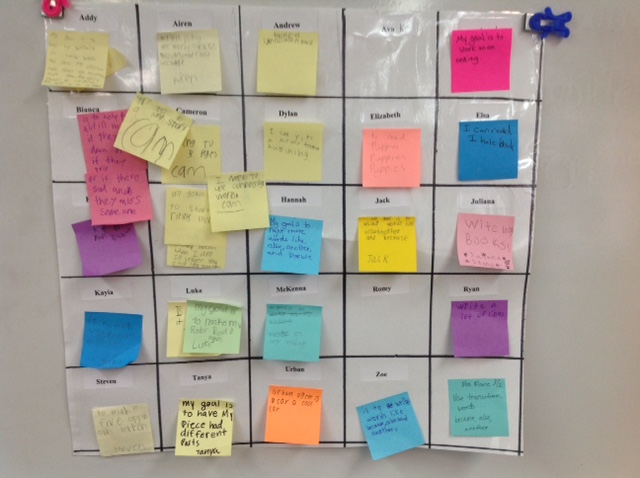
2nd gr goal setting - Moore.jpg
This 2nd grade example stems from students reflecting on their most recent piece, comparing their piece to the Units of Study Opinion Writing Checklist, and identifying an area or 2 they want to focus more deliberately on for their next opinion letter.  As students work, they are able to refer to the checklist indicators to assess their progress toward improving in their identified area. The teacher is able to focus conferences around the students goal area, as well as differentiate small group instruction based on goal trends. The students are vested and have a high level of accountability in accomplishing their goal as they assess their writing, determine goals and monitor progress during the unit.
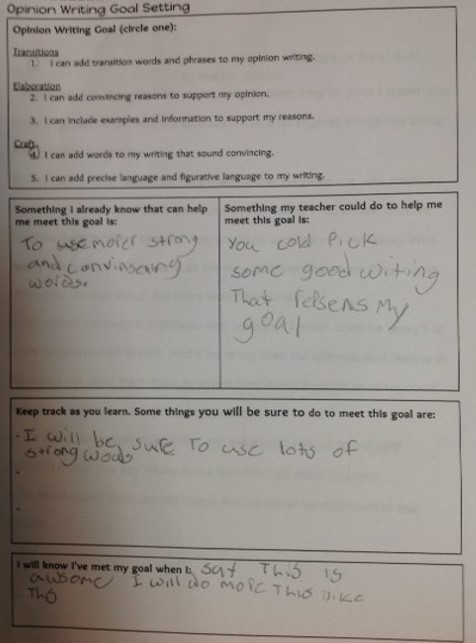
Students in this 4th grade class set a goal for improving their opinion essays. Students engaged in a discussion with partners where they explored these questions:
  • Why is it important to set goals?
  • What can having goals do for us?
Then, they looked at their pre-assessment with boxes marked on the Units of Study Opinion Writing Checklist by their teacher.  It was explained to students that the marks on the checklist were based on what they should be able to do at the end of all the lessons in the unit. Then students looked at their writing and the checklist, they considered all the examples of good writing that had seen so far. Finally, they decided which goal they thought they could achieve by the end of the next essay.  As a class, they walked through each box on the Writing Goal Setting sheet and completed the boxes based on their reflections and thinking. As often as they can, they come back to this goal setting sheet and add to it so they can  hold themselves accountable for the goal.
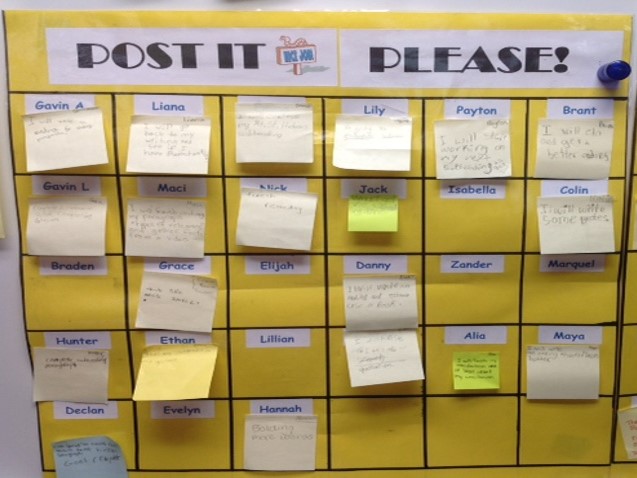
4th gr goal setting - Clemsen.jpg
In writing, students use the Checklist that is in our Units of Study Curriculum. They choose something on the checklist that they are working on in their writing for the day. Then they write the goal on a post-it. This strategy makes it easy for the teacher to do a quick check as to who is working on what component. Also, it is easy to see who is working on the same thing, in order to group students based on goals to pull for conferencing.
One teacher has even used this chart for building silent reading stamina.  As a class, they set a reading goal in minutes. Then they wrote down their starting and ending page number in their silent reading book to track pages read. This has increased stamina, and seems to keep them focused during silent reading.
This 4th grade goal setting session came about after the teacher noticed her students were particularly challenged at solving word problems.  Because the next unit provided a lot of additional practice solving word problems, she wanted students to focus on this during the unit.  At the conclusion of the previous unit, they talked about flaws and the importance of flaws in the learning process.  When student received their unit assessment back, they were asked to silently look through their assessment focusing on what they do well when solving word problems, primarily with the three identified statements, and complete the Unit Assessment Reflection.  They were also able to add their own thinking if there was an additional trait that they thought better described their work. Then, they found a problem that was answered incorrectly (they needed to write down the problem number so that the teacher could find the problem) and how they solved it.  They then had the opportunity to try to fix the flaw in their solution and identify if they could find the flaw as well as what type of flaw it was (discussed this previously as well). Finally, students were asked to create a goal for the duration of the unit and unit test